
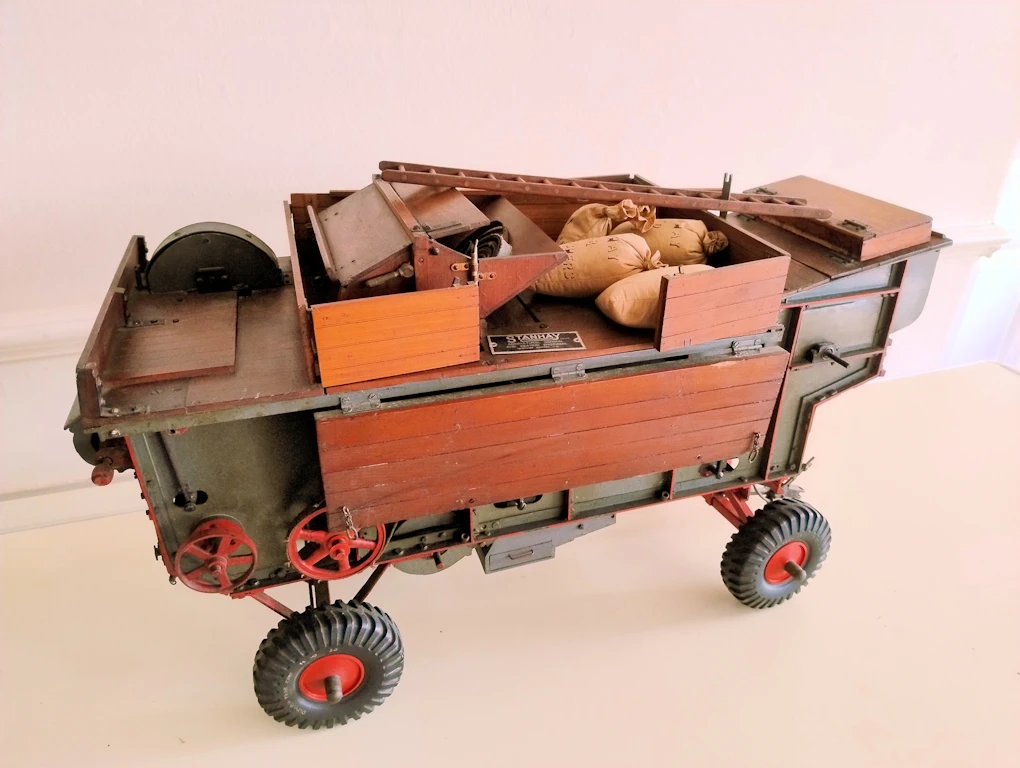
The model threshing machine was built by apprentices of Stanhay (Ashford) Ltd.
The model was probably built as a final piece by apprentices of the agricultural engineering company that was based in Ashford. It was constructed over a period February 1949 and June 1950.
It is based on the steel framed Fisher Humphries Threshing Machine, model SFA1. It is believed that all moving parts of the model operated as the full size machine.
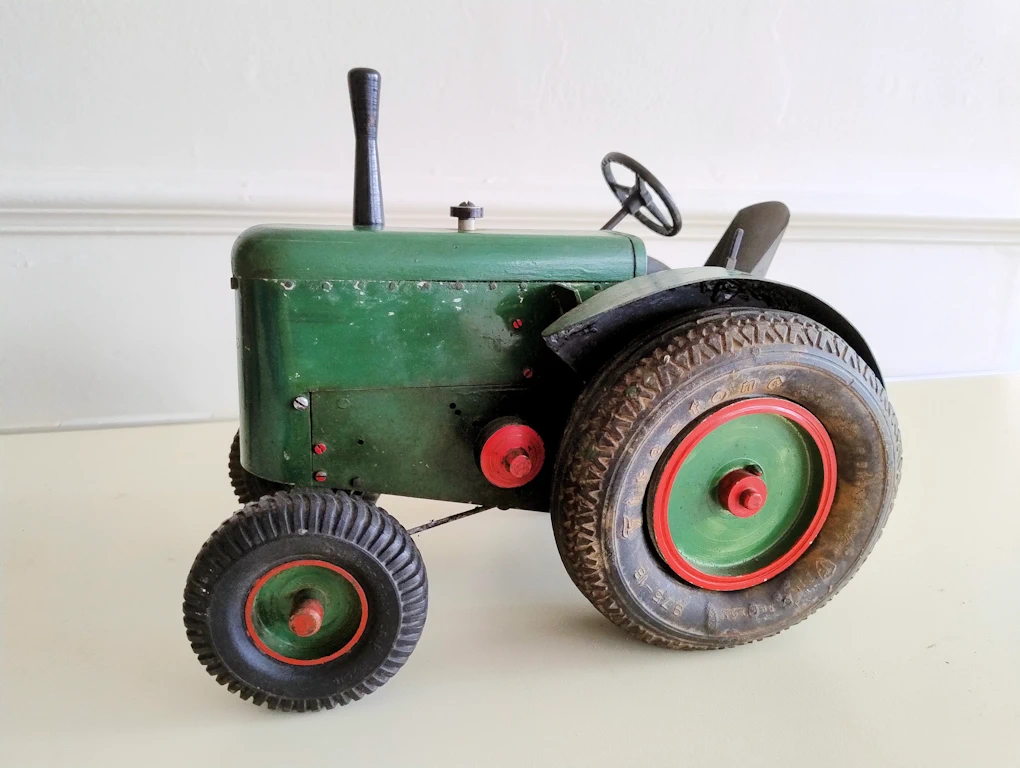
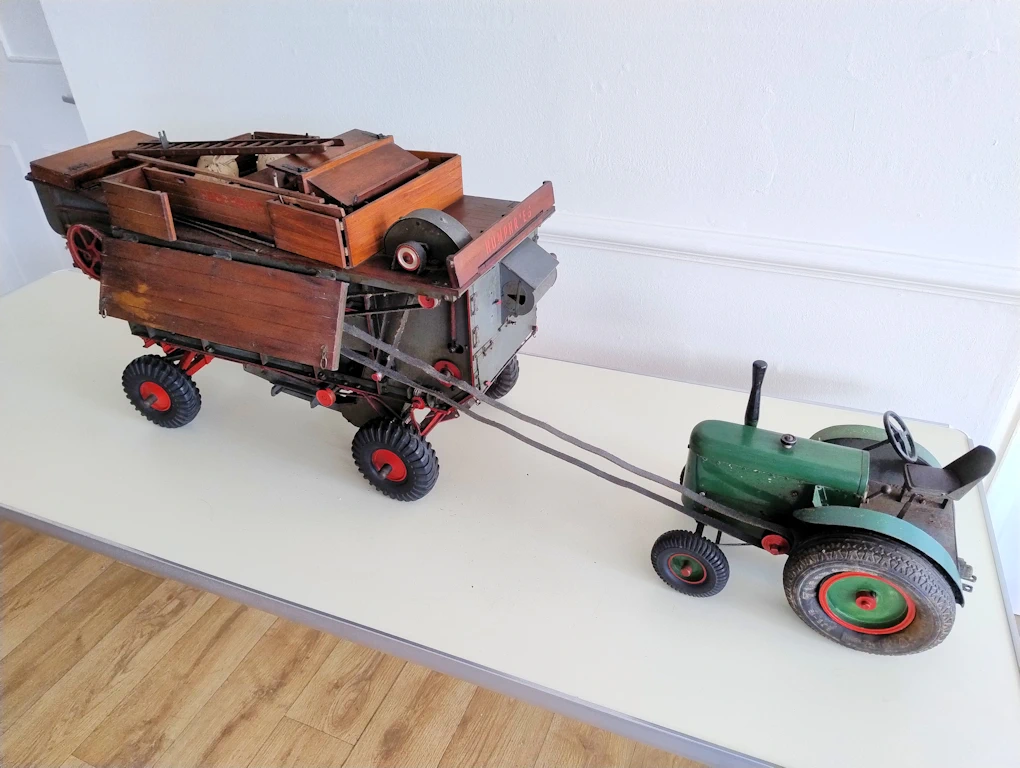
The tractor displayed with the threshing machine is a model of a Marshall & Sons, Field Marshall single cylinder diesel tractor. It has an electric motor which would have driven the threshing machine.
The threshing machine was displayed at the Kent County Agricultural Show in 1950. Ashford Museum, with partner Wheels of Time venues, displayed it again at the County Show in 2024.
The large rear tyres on the model came from a souvenir ash tray. Such ash trays became a common promotional product used by tyre manufacturers from the early 20th century.
Fisher Humphries & Co. Ltd.
E & T Humphries Agricultural Engineers was formed in first half of the 19th century by brothers Edward and Thomas Humphries. They made their first mechanical thresher in 1832.
On the death of Thomas in 1858 the company was renamed and incorporated as Eward Humphries & Company Ltd.
In 1883 the company moved to new premises known as Atlas Works in Pinvin, Pershore.
In 1903, cheap imports caused the company to go into liquidation.
The company’s assets were bought by Bomford & Evershed Ltd. in 1904.
In 1908 Bomford and Evershed moved to Salford Priors, Evesham selling Atlas Works and the manufacture of threshing machines to Horsfall Destructor Co., Ltd., which later became Fisher Humphries & Company Ltd.
Fisher Humphries produced their first steel framed threshing machine in 1934.
Fisher Humphries became part of the Dutch agricultural machinery firm, Lely.
Field Marshal Tractors.
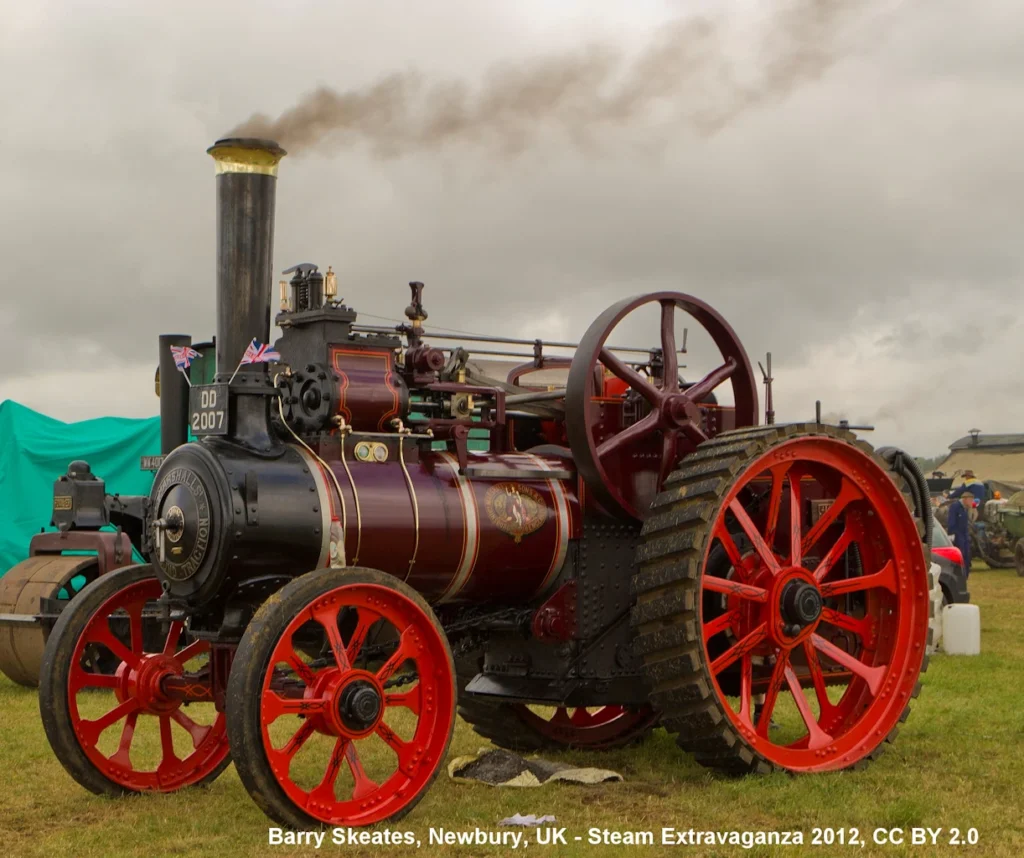
Marshall, Sons & Co. of Gainsborough, Lincolnshire was a long-established engineering company dating from 1848 which had specialised in steam and, to complement this, offered threshing mills too.
However the arrival of the internal combustion engine did not go unnoticed and as the days of steam appeared to be numbered they began to offer oil-engine tractors early in the 20th century.
The Great War stimulated much work for Marshall but after the conflict when the demand for steam engines fell rapidly Marshall looked east to Germany where their single-cylinder Lanz Bulldog diesel tractors were proving very popular. So in 1928 Marshall started working on its own design of this type of tractor. This resulted in series of models, the 15/30 in 1930, the 18/30 in 1932 and 12/20 in 1936,from 1938, to be known as the Marshall M.
Even with the start of WWII in September 1939 Marshall continued to build the Model M amid many government contracts but shortages meant having to use parts originally manufactured for the M’s predecessors, meaning a loss of standardisation.
Despite the rigours of war Marshall’s designers managed to work on improvements to the Model M and instigated plans to build a successor in 1943. Field testing went well and the tractor offered more power over its predecessor and was turned out in a more streamlined look with curvy tin work around the nose cone. Painted in a slightly darker green colour of Brunswick green the new tractor had the wheels turned out in silver along with silver lining, trim and embellishments. A new corporate logo of a clenched fist holding a torch also appeared on the side of the tractor. Initially cast wheels were used before pressed steel examples arrived. The cigar-shaped Burgess exhaust pipe was one of the distinguishable features of the tractor as was the continued mounting of the radiator core on the side.
Given the name of the Field Marshall in line with the new corporate ethos, it had two versions – the MK 1 and the MK II, with the latter aimed at contractors. With the subsequent models being named as Series 2 and Series 3 tractors history has given the first Field Marshall the title of Series 1.
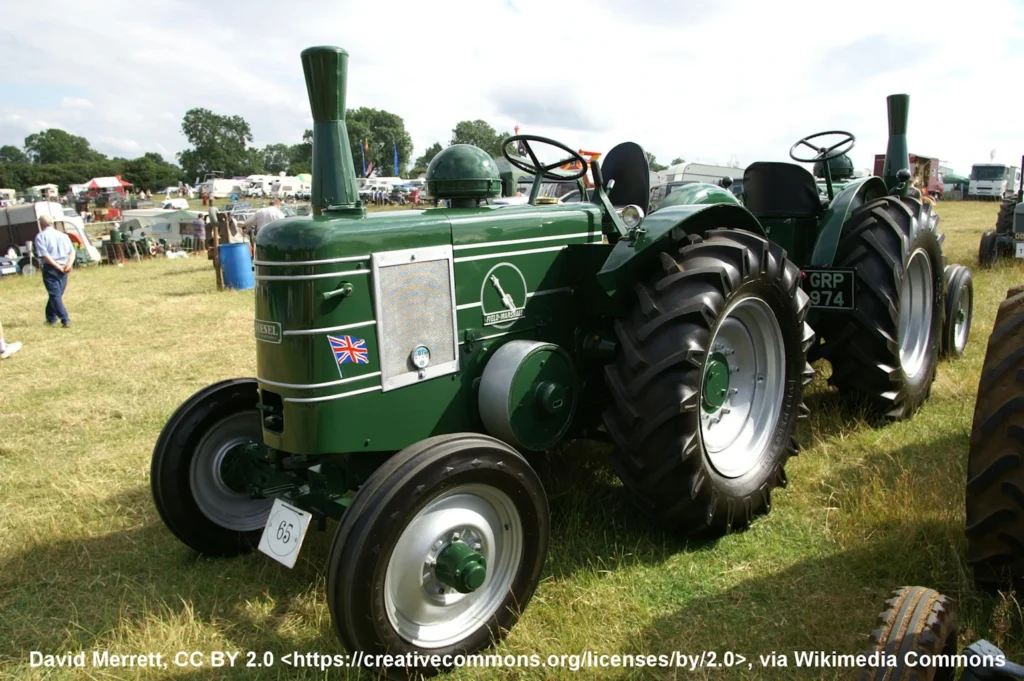
Although a sales success, it was not without its quirks however. In particular, its starting procedure took some practice and was a direct hang-over from the older engines. A farmer had first to pre-heat the cylinder with a flaming taper. The lit wick had to be inserted into the cylinder head and left to heat the metal to the point at which the fuel could ignite. While the metal reached temperature, a blank shotgun cartridge had to be fitted into a breech on the intake manifold, and covered with a steel cap. Once the required time had passed and the engine was hot enough to run, with a strong blow from a hammer the cartridge would be fired into the engine creating enough detonation to move the piston through its first full stroke. As it came to life, it produced a clatter that only a 6 litre two-stroke diesel engine could produce, loud, slow and unique.
This lengthy process meant that once running, many farmers would avoid switching the engines off wherever possible. The weighty “thump” of the large engine at tickover led to the second characteristic of the Field Marshall tractor – its ability to shake itself into muddy ground in minutes. Many owners experienced returning to machines that had sunk to their axels in mire, needing teams of men, horses and other tractors to free these stricken beasts from their self-dug graves.
Eventually the firm offered a popular starting cartridge method for inserting and detonating to aid starting. Indeed, the single cylinder diesel format proved to be a major seller for these tractors among threshing contractors who loved the frugality of the engines that could sit all day driving mills without the problems of the spark plugs of petrol paraffin tractors oiling up.
With the use of steam in agriculture coming to an end following the war, many of Marshall’s steam-threshing customers turned to the new tractor to operate the threshing mills. They found them to be a godsend with low running costs associated with the single cylinder diesel engines and no early starts to raise steam long before threshing could begin.
Threshing contractors’ Mark 2 models were fitted with winches for moving tackle into position while lighting was fitted for travelling during darkness in winter and for protection from the elements a canopy was fitted over the driver’s platform.
Marshall continued to improve the designs of the tractor which led to the launch of the Series II in 1947 and the Series III in 1950 and the IIIa in 1952 a year later.
The Marshall range of crawler mirrored changes of the tractor range until production of both wheeled and tracked typed ended in 1956 after falling behind the competitions’ more modern high speed multi-cylinder diesel engine tractors.
Quirks aside, the Field Marshall’s reputation for bombproof engineering meant that they remained a huge part of British agricultural life and were a familiar site on farms for decades after production ceased.
Despite a brief excursion into multi-cylinder diesels with the MP4 and MP6 models, Marshall concentrated itself with the crawler market under its own name with multi-cylinder diesel engines and left wheeled tractors behind.
That is until the then owner of Track Marshall bought the tractor division from British Leyland and moved production from Bathgate to the old Gainsborough factory in 1982 and rebranded the Leylands as Marshalls.
Peter Small, 2015, ‘A look back at the history of Field Marshall tractors’, The Press & Journal, https://www.pressandjournal.co.uk/fp/business/farming/641020, accessed 2nd July 2024 Starting with a bang: the field marshall diesel tractor, https://www.footmanjames.co.uk/blog/field-marshall-diesel-tractor, accessed 2nd July 2024
Leave a Reply