
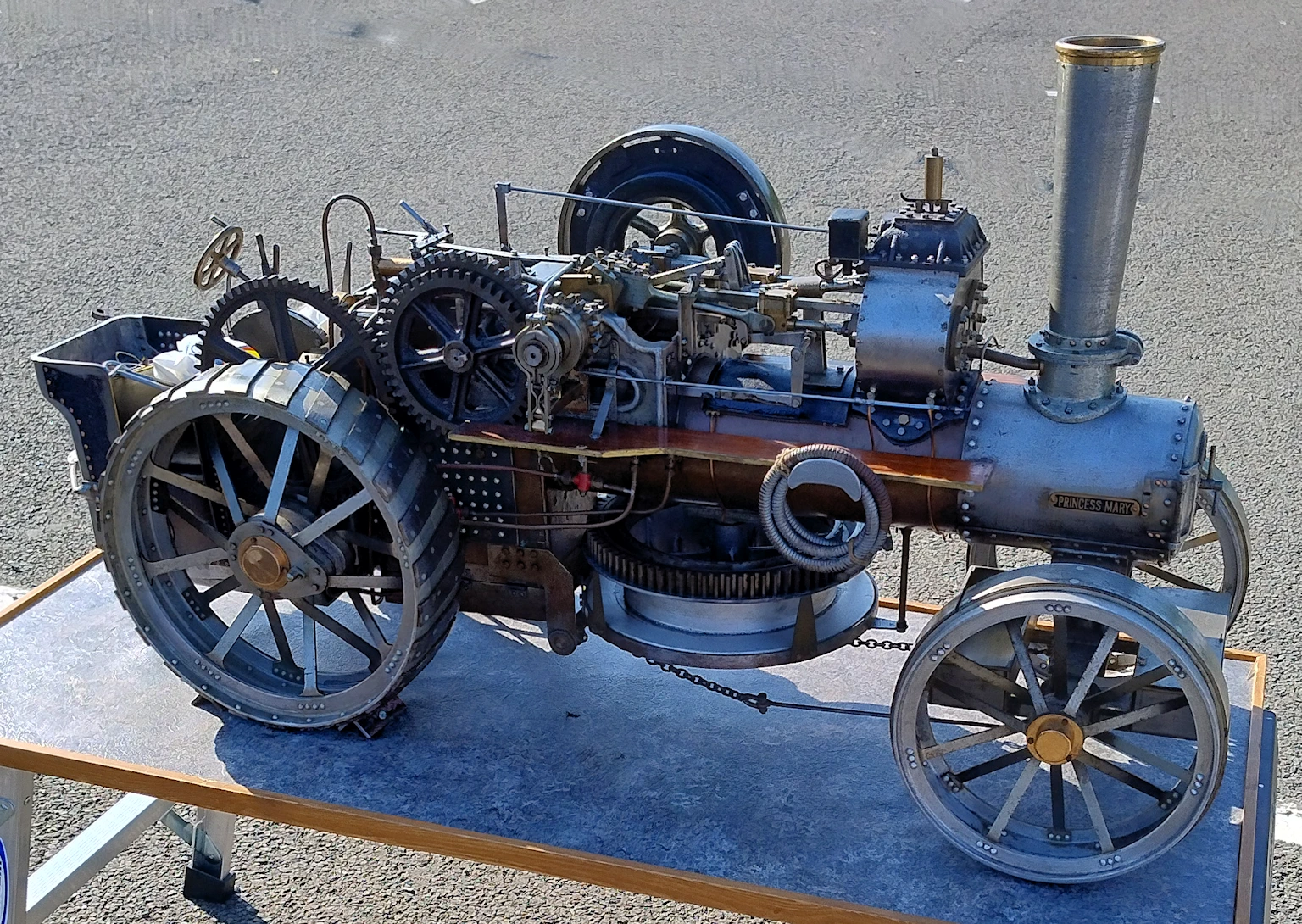
The engine that this model is based on was built by
John Fowler & Co., (Leeds) Ltd.,
in 1920,
as works No. 15436,
Class: BB1, Ploughing Engine
having a nominal power of 16 HP
given the name Princess Mary.
They were normally sold and worked in pairs with an identical but handed engine
The model traction engine, was built to be fully working by apprentices at Ashford Railway Works between 1968 and 1972.
John Fowler
11 July 1826 – 4 December 1864
John Fowler son of Quaker Merchant, John Fowler and Rebecca Hull, was born in Melksham, Wiltshire
When he left school Fowler began working for a local corn merchant, but when he came of age in 1847 he changed career and joined the engineering firm of Gilkes Wilson and Company of Middlesbrough.
Ploughing Engine design
At the time of the Great Famine, Fowler made a chance visit to Ireland where the agriculture depended on the potato crop, whilst much of the land was uncultivated due to poor drainage. Fowler was convinced that there must be a way of bringing more land into production. The normal way to drain agricultural land was to use a mole plough to dig a subterranean drainage channel. The mole plough has a vertical blade with a cylindrical “mole” attached to the bottom. The mole is pointed at the front end, and as it moves through the soil, it leaves a horizontal channel into which porous drainage pipes can be laid. However this required considerable tractive power, so that the size of the plough was limited by the strength of the teams of horses that pulled it.
Over a period of four years Fowler developed first a horse-powered ploughing engine that would dig drainage channels. His first design being demonstrated at a meeting of the Royal Agricultural Society of England at Exeter in 1850, when he was able to lay a drain at a depth of 2 ft 6 in (0.76 m) in heavy clay. Gaining a silver medal and a second design at the Great Exhibition in 1851 and at the Royal Agricultural Society of England meeting at Gloucester in 1853, where he was awarded another silver medal. He was able to lay drains to a depth of 3 ft 6 in (1.07 m).
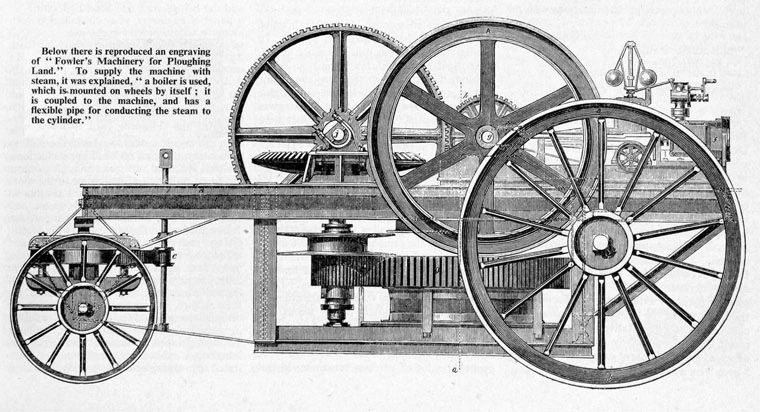
He went on to design a steam engine with a winch mounted out in front of the smoke box and a rope running from it, round a pulley anchored at the far side of the field and back to the engine. The engine pulled itself across the field, dragging the mole plough behind it; for which he was awarded patent number 480 for “Improvements in Machinery for draining land”, believed to be one of the first patents for the use of steam power in agriculture.
A further development of the steam plough was demonstrated at the Royal Agricultural Society of England meeting at Lincoln in 1854.
Steam-driven plough
It seemed an obvious progression to use Fowler’s latest steam-driven plough for normal ploughing, rather than just drainage channels. To improve the plough’s efficiency Fowler designing a frame for the plough that had two ploughs attached as a kind of see-saw. One of the two plough blades would be swung down to make contact with the soil, depending on the direction the plough was to travel. At the end of each furrow the anchored pulleys would be moved slightly ready for the next furrow.
The firm of Ransome and Sims built the new engine at its Orwell works at Ipswich, and on 10 April 1856 a trial was carried out at Nacton in which 1 acre was ploughed in an hour. Despite the fact that the engine and plough coped well with the task, the effort of re-positioning the pulleys at either end of the field was too time-consuming.
A further development a weighted cart with a pulley mounted beneath the frame. Two carts would be placed at opposite ends of the furrow so as to pull the plough in either direction, and after completing a furrow, the carts would be winched to the position for the next furrow.
Double-engine ploughing
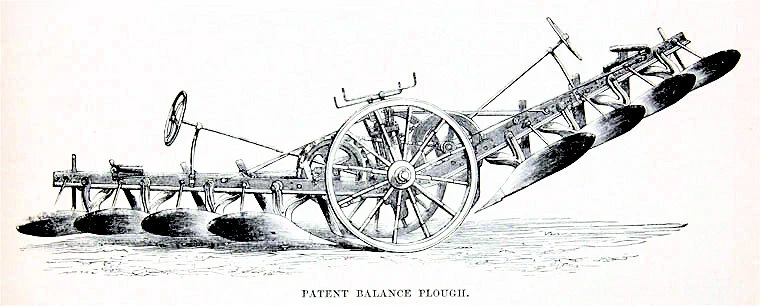
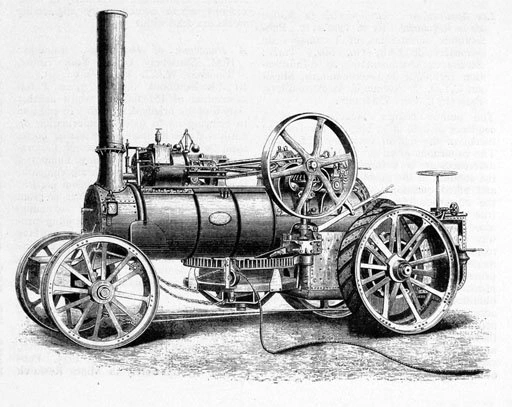
In 1856 Fowler filed a patent relating to a method of ploughing using two self-moving engines, placed at opposite ends of the field and each using a winch to draw a plough backwards and forwards between them. Eventually the double-engine ploughing method superseded the single-engine system. Because of its expense it was normally operated by contractors.
Between 1850 and 1864 Fowler took out in his own name and in partnership with other persons thirty-two patents for ploughs and ploughing apparatus, reaping machines, seed drills, traction engines, slide valves, the laying of electric telegraph cables, and the making of bricks and tiles.
By 1858 Fowler had forty sets of ploughing tackle in use, and by 1861 he had one hundred sets working. From 1860 the manufacture of the ploughing machinery was carried out by the firm of Kitson and Hewitson of Leeds.
John Fowler & Co. Ltd.
In 1862 Fowler formed a partnership with William Watson Hewitson of the above firm and founded Hewitson and Fowler based at Hunslet. A year later Hewitson died and the firm became John Fowler and Company. Fowler’s ploughing sets were sold all over the world and were responsible for bringing land into production that was previously unable to be cultivated.
Retirement
Only a year after the formation of John Fowler & Co., Fowler’s own health suffered and He was advised to take more rest and so he retired to Ackworth in Yorkshire, to recuperate. He took up hunting as a way of getting exercise and whilst out with the hunt he had a fall and sustained a compound fracture of his arm. Whilst recovering from this mishap, he developed tetanus and died on 4 December 1864, at his home in Ackworth.
His brothers Robert, William and Barnard had joined him in the business he had founded and they continued to run the firm after his death. Fowler’s method of ploughing continued to be used until well into the twentieth century when the internal combustion engine allowed the development of light but powerful tractors that could draw a plough behind them.
Leave a Reply